
Aikido was created by a Japanese master of Budo named Morehei Ueshiba. Ueshiba is most commonly referred to as O'Sensei which means Great Teacher. O'Sensei was born on December 14, 1883 in Tanabe prefecture, Japan. As a child, he was rather sickly and prone to illness. During these younger years he was much more inclined towards the academic and spiritual pursuits than the physical ones. Even at a young age he demonstrated great aptitude for things mathematical and spiritual. At around age seven he began studying Shingon Buddhism and then later Zen Buddhism. This was very important as it helped build a solid spiritual foundation that would become a cornerstone for his path later on. Because of his frail nature and tendency towards academics, his father encouraged young Morehei to engage in more physical activities such as sumo and swimming.
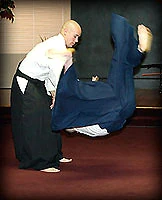
Around the age of 12, O'Sensei's father was roughed up by some local hoodlums. Intent on avenging his father's beating, he vowed to strengthen his body and began a pursuit of physical power and martial prowess. It was at this point that he began to lead a life committed to the deepest understanding of budo. O'Sensei studied many arts during his life time and was considered to be a master of many of them. His studies included Kenjutsu (particularly the Yagyu Shinkage-ryu of swordsmanship), jodo, sumo, as well as Aioi-ryu Jujitsu and Hozoin-ryu spear and bayonet arts. Each of the arts he studied influenced his beliefs and eventually helped him to form the art of Aikido.
Two arts in particular seemed to have been the most influential in the development of his philosophies. Swordsmanship and Jujitsu are seen very easily in O'Sensei's Aikido. The development of Aikido, however, was truly set on its way with O'Sensei's introduction to two people. In 1912 he met a Daito-ryu Jujitsu master named Sokaku Takeda. Daito-ryu was a particularly fierce and unforgiving form of Jujitsu. This would be a major event in his life as it was the point where the powerful techniques of Aikido were planted. Takeda Sensei was a notoriously tough and powerful individual whose reputation as a devastating fighter was known throughout the martial arts world. O'Sensei studied with Takeda for many years, serving as his Master's personal deshi, or disciple, and eventually gained his master teaching certificate. His studies ended in 1919 when he received word of his father's imminent death. It was during his travels home that he met the second person that would be a major influence on the formation of Aikido.
Daito-ryu was a particularly fierce and unforgiving form of Jujitsu.
During his journey homeward he came across Onasiburo Deguchi, master of the Omoto-kyo ("Teaching of the Great Origin") Shinto religion. This sect was known for its meditation techniques designed to unify one's spirit with the Divine. This meeting would change O'Sensei forever. Deguchi taught world peace and harmony as well as the idea that the truth of budo was to protect and prevent conflict. O'Sensei would stay with Deguchi for the next ten years while he continued his martial arts training and spiritual growth. During this time O'Sensei experienced enlightenments that would profoundly affect the face of what would be known as Aikido. Up to this point, the martial arts were very harsh and designed to inflict severe damage to "the opponent", often leaving crippling injuries on its practitioners. O'Sensei saw this as self-defeating, even to the "winner" and recognized a need for change in an evolving cultural climate. Rather than viewing uke and nage (attacker and defender) as separate and conflicting entities, he viewed them as a whole, for without one there was no need for the other. Thus O'Sensei recognized the need for the physical waza (technique) to evolve in such a way that it intertwined his spiritual philosophies and yet remained a practical and effective system of martial arts.
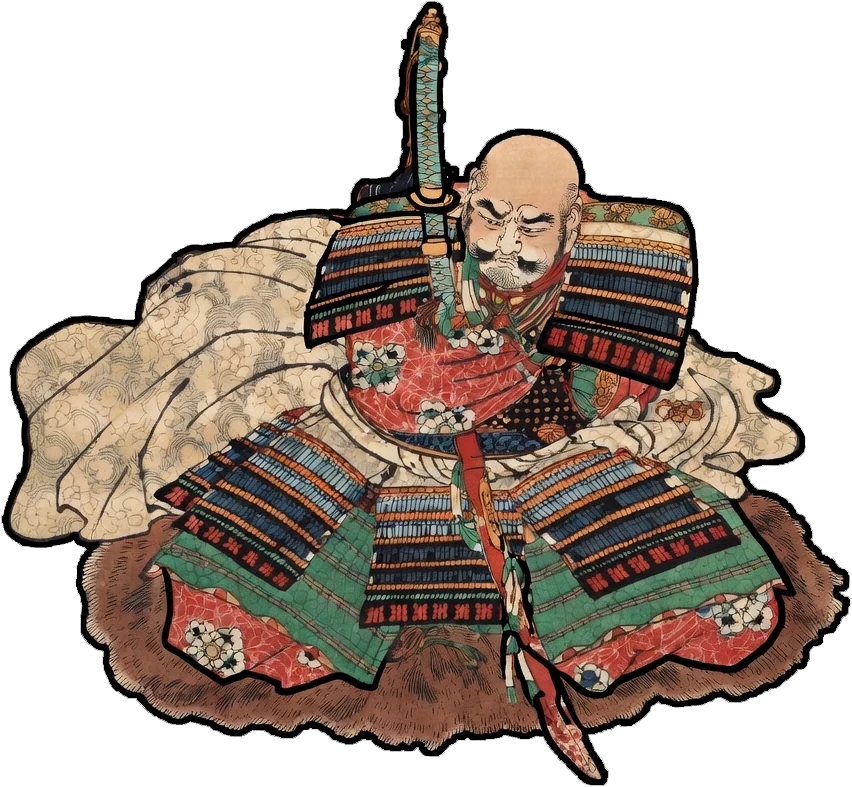
In 1925, a naval officer visited O'Sensei's dojo and challenged him to a duel with a bokken (wooden sword). Rather than fight the challenger, O'Sensei met the officer's strikes by merely moving out of the way of his increasingly frantic strikes until the officer lay down, exhausted, defeated by his own aggression. O'Sensei was able to emerge victorious without ever having landed a blow or injuring his opponent. Afterwards, O'Sensei walked out into his garden and, in his own words, experienced a "golden light" descending on him from heaven, accompanied by complete clarity of thought and a unification of mind, body and spirit. It was then that he realized that "The true purpose of budo is the loving protection of all things." This is the philosophy that lies at the heart of all aikido. Two years after that, Deguchi encouraged O'Sensei to separate from the Omote-kyo and begin his own "Way". Deguchi felt that O'Sensei had come as far as he could there and that he had a special gift to give to the world. The gift could only be developed through the establishment of his own style. O'Sensei agreed and moved to Tokyo. Over the years it took Aikido to be formed, it had many names. Ueshiba-ryu Aikibudo was the most common name used until O'Sensei decided to settle on the name Aikido in 1942. Aikido is composed of three characters: Ai (Harmony), Ki (Energy), and Do (Way). Together they create "The Way of Harmony with Energy." Aikido soon became an established and respected art sought out by the highest levels of Japanese society.
“The true purpose of budo is the loving protection of all things.”
Around this time in 1942 O'Sensei decided to deepen his studies of budo which led to his leaving the Hombu Dojo to be run by his son Kisshomaru Ueshiba. O'Sensei returned to Iwama which is where the Aikido we see today took most of its form. Aikido became softer, and focused much more on the blending principles O'Sensei emphasized from his religious background. During the years of 1942-1952 it is believed that O'Sensei consolidated techniques and perfected the philosophical aspects of today's Aikido. Aikido grew and eventually came to the United States. O'Sensei believed that Aikido could be the tool to bring peace into the world. Unfortunately O'Sensei never saw his dream realized. The martial arts world lost one of its most powerful and influential masters on April 26, 1969 when O'Sensei Morehei Ueshiba passed away at the age of 86. Following in his footsteps was his son, now called Doshu. Doshu carried on O'Sensei's dream and strove to strengthen the bond among Aikidoka. His efforts produced fruits beyond expectation. As with his father, Doshu passed away before the true dream of Aikido could be realized. He has left his son, Morihito Ueshiba, as the new Doshu who carries with him the hopes and dreams of a million Aikidoka.
Aikido at PMA: adults, Monday and Wednesday at 7:30 p.m.